
Therabody’s Palm Cooling Technology Improves Resistance Training Performance, Study Shows
Published:
Last updated:
Expert contributors: Bailey McLagan, PhD(c); Jake Heydon, MS, University of Southern California
A new randomized crossover study found that Division I athletes who used a palm-cooling device between heavy sets of overhead press were able to do 28% more total work (defined as weight lifted x sets x repetitions) than those who did not use the palm-cooling technology.
When using palm cooling, athletes also performed 58.3% more repetitions during the final set compared to control, which is typically when fatigue sets in. Plus, they reported lower perceived exertion during sets 2-4. Post-session grip strength was better preserved during the cooling condition.
Here, we’ll cover what happened as athletes used a palm cooling device between sets, how the study was conducted, and what these findings may mean for high-intensity resistance training.
Why fatigue between sets limits performance
Researchers quantify the overall stress of a training session using total work volume. When fatigue limits repetition performance, total work volume decreases — which can reduce the amount of high-quality work performed within a session. [1]
During a strength training session, fatigue builds across repetitions and sets. As neuromuscular and metabolic demands increase, performance typically declines, and fewer repetitions can be completed in later sets. [2]
You’ve likely experienced this: your first set feels strong, but by the third or fourth set, the same weight feels heavier, and you reach failure sooner. For athletes training at high intensities, even one additional repetition per set can meaningfully increase the total work performed in a session, and interventions that help delay fatigue are increasingly critical to performance.
How palm cooling delays fatigue during resistance training
Your palms play an important role in how your body releases heat. Previous research has shown that removing heat from the palm during rest periods may help delay fatigue during high-intensity resistance exercise. [3, 4]
One proposed explanation is that extracting heat from the palm helps reduce localized thermal strain during repeated high-effort sets. Removing heat during rest intervals may influence thermal and sensory signals sent to the brain, which can contribute to the perception of effort and fatigue during intense exercise. [3, 4, 5, 6]
Because resistance training sessions are short and intermittent, the effects observed in this study are unlikely to be explained by large reductions in whole-body temperature alone. Instead, fatigue during heavy lifting reflects an interaction between muscular fatigue and central nervous system regulation. [7, 8] In this context, palm cooling may influence how fatigue signals develop and are perceived across successive sets, helping athletes sustain performance.
The present study did not directly measure the underlying physiological mechanisms, but the findings are consistent with broader research suggesting that managing thermal strain can influence fatigue development during intense exercise. [9, 10]

How the study was conducted
Participants
Twenty-one highly trained Division I athletes (52% female) completed the study. Participants were 18–35 years old and had at least two to three years of consistent upper-body resistance training experience. Based on established performance classification frameworks, the athletes were categorized as Tier 4 and Tier 5 competitors, reflecting collegiate- and near-elite-level training status. [11]
Study design
The study used a randomized crossover design. Each athlete completed both conditions — palm cooling and thermoneutral control — separated by a one-week washout period. This means every participant served as their own comparison. Athletes completed three laboratory visits:
- Visit one: Baseline testing, including 10-repetition maximum testing (10RM)
- Visits two and three: Experimental trials (exercise protocol with cooling condition vs thermoneutral control)
- One-week washout between conditions
During the control condition, the device was placed on the palms but not turned on.
Exercise protocol
At the baseline visit, athletes completed a 10RM seated overhead press test. That value was used to estimate their one-repetition maximum (1RM), and all experimental sessions were performed at 85% of that estimated 1RM. Repetition performance at high percentages of 1RM typically declines across sets as fatigue accumulates. [12]
During each experimental session, athletes performed four sets of seated overhead press to failure, with 2.5 minutes of rest between sets.
Repetitions were defined as full range of motion without assistance. Athletes were instructed to complete as many repetitions as possible but were not cued to move the bar at maximal speed.
Table 1. Study protocol

Cooling vs. control condition
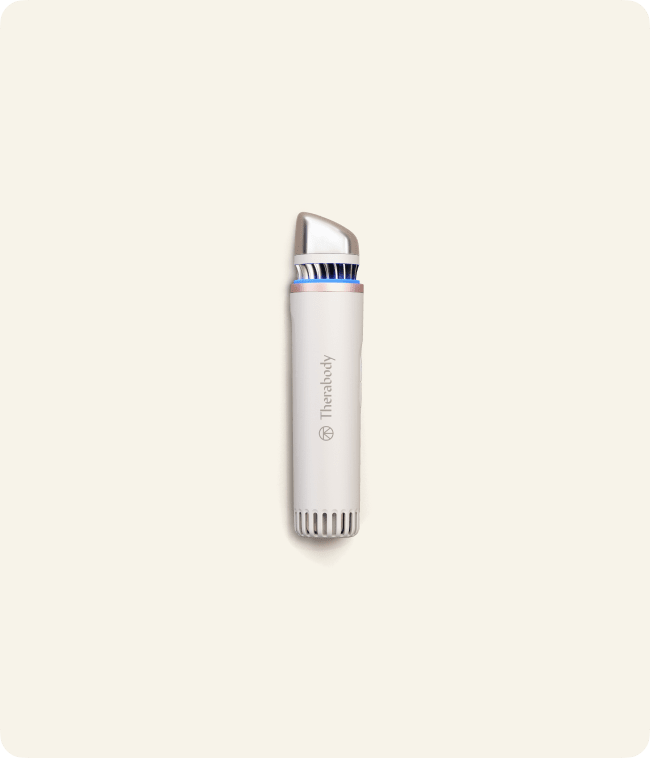
Before the first set and during every rest interval, athletes held a device using cryothermal® technology in both palms for the full 2.5-minute rest period.
- In the cooling condition, the device was set to 12°C (53.6°F).
- In the control condition, the device was placed on the palms but not turned on, remaining thermoneutral.
Earlier palm cooling studies relied on water-based or larger systems that are harder to control and less practical in real training environments. In this study, researchers used a cooling (Peltier-based) device set to 12°C (53.6°F).
Cooling was applied only during rest periods, not during the lift, and did not extend the workout or alter the prescribed load or rest duration. Practically, this means you can apply cooling during your normal rest period — without adding extra time, changing your weight selection, or altering your workout structure.
“A key strength of this study is that it evaluated palm cooling within a realistic, high-performance training environment,” says Bailey McLagan, PhD(c), a doctoral student at the University of Southern California and investigator on the study. “Thermoelectric cooling allows for precise, repeatable temperature delivery directly to the palm. That level of control — maintaining a consistent 12°C stimulus during each rest interval — is difficult to achieve with traditional cooling modalities.”
What researchers measured
Researchers assessed:
- Total work volume (load × sets × reps)
- Repetitions performed per set until fatigue
- Rating of perceived exertion (RPE) using the 11-point OMNI scale. [13]
- Grip strength before and after the session
- Bar velocity loss using a velocity-based training device
Velocity loss is commonly used as an indicator of neuromuscular fatigue during resistance training. [14] Movement velocity also reflects relative loading intensity. [15] More recent research supports its sensitivity in detecting acute fatigue during multi-repetition resistance exercise. [16]
Researchers also checked whether simply repeating the workout influenced performance (learning, order, or carryover effects). They found no evidence that results were affected by learning or by which condition athletes completed first.
Palm cooling increased total work volume by 28%
Athletes completed 28% more total work during the cooling condition, which was significant compared to control.
Because the load and number of sets were identical in both conditions for each athlete, the difference was driven by the ability to perform additional repetitions before reaching fatigue.
“What stood out most was how consistently participants were able to maintain performance across sets when palm cooling was used,” says Jake Heydon, Master’s student at USC and lead investigator. “Rather than seeing the typical decline in repetitions or total work as fatigue accumulated, performance was better sustained throughout the session. This suggests the intervention didn’t just provide a small boost, but meaningfully influenced how fatigue developed during the workout, both in terms of performance outcomes and perceived effort.”
Key takeaway: Total training volume supports muscle growth. The athletes in this study were able to sustain a higher effort during a session, potentially contributing to the higher-quality work that builds muscle.
Athletes performed significantly more repetitions — especially in later sets when fatigue typically sets in
Athletes consistently completed more repetitions per set during the cooling condition compared to control. In fact, the gap between repetitions completed widened in the later sets between the conditions. Compared to thermoneutral control, on average, participants completed:
- 14% more repetitions in set one
- 24% more repetitions in set two
- 31% more repetitions in set three
- 58.3% more repetitions in set four
The largest difference occurred in the fourth set, when fatigue would normally be highest.
Key takeaway: Later sets often determine the overall quality of a resistance training session. Delaying fatigue allows athletes to maintain output during repeated high-intensity efforts, supporting training adaptation.
Palm cooling reduced perceived exertion across successive sets
While there was no significant difference in perceived exertion during the first set (meaning both groups felt similar at the beginning of the workout), athletes in the cooling group reported significantly lower RPE in sets 2-4.
However, in sets two through four, athletes reported significantly lower RPE during cooling:
Table 2. RPE results
|
|
Cooling |
Control |
% Difference |
|
Set 1 |
6.95 ± 0.59 |
7.09 ± 0.80 |
2.0% |
|
Set 2 |
7.26* ± 0.64 |
8.12 ± 0.61 |
10.6%* |
|
Set 3 |
7.83* ± 0.46 |
8.71 ± 0.77 |
10.1%* |
|
Set 4 |
7.96* ± 0.73 |
9.43 ± 0.66 |
15.6%* |
*P<0.05
“The reduction in perceived exertion across later sets is particularly significant,” says McLagan. “How we experience fatigue can dramatically alter how we experience exercise. When an intervention alters how effort is perceived without changing external load, that has implications for effort sustainability throughout the session.”
The gap between conditions widened as the session progressed, meaning the cooling condition felt less impact of fatigue than the control.
Key takeaway: As fatigue accumulated, athletes reported that later sets felt less demanding than the same sets in the control condition. That difference in perception may help explain why they were able to complete more repetitions and sustain higher total work volume.
“Long-term training adaptations are closely tied to the amount of high-quality work an individual can perform over time,” Heydon explains. “If an athlete can complete more total work in a session without increasing perceived effort or extending workout duration, that creates a stronger stimulus for strength and muscle adaptations. Even modest improvements at the session level can accumulate into meaningful differences over weeks and months of training.”
Grip strength was better preserved after training
Grip strength declined in the control condition but was preserved in the cooling condition. On average, post-session grip strength was 7% higher during cooling compared to control.
Reductions in maximal force output are a defining characteristic of neuromuscular fatigue. [7, 8] For performance, maintaining strength as fatigue builds can support better bar control, stability, and more consistent effort during heavy lifts. While this study examined only one training session, preserving strength during a workout suggests improved tolerance to high-intensity training.
Key takeaway: Grip strength is a simple way to measure how much force you can still produce when you’re tired. In this study, athletes were better able to maintain that force with palm-cooling.

Bar velocity showed small differences between conditions
Mean propulsive velocity loss was slightly greater in the cooling condition, but pairwise comparisons showed no consistent interaction across sets.
This is an especially intriguing finding, as participants were instructed to complete repetitions to failure rather than prioritize maximal concentric speed.
Key takeaway: Velocity-based metrics are sensitive to fatigue. [14, 15, 16] However, movement intent influences results. In this protocol, repetition completion rather than speed was prioritized, so velocity findings should be interpreted within that context.
What these findings mean for your training
This study examined the effects of palm cooling during a single high-intensity upper-body workout in highly trained collegiate athletes. Within that session, cooling the palms between sets increased total work volume, helped sustain repetitions as fatigue accumulated, lowered perceived exertion compared to control, and preserved grip strength — potentially accelerating recovery between sets.
“These findings are most applicable to resistance-trained individuals and coaches working in high-intensity training environments,” says Heydon. “When session quality depends on sustaining output across multiple heavy sets, even small shifts in fatigue trajectory can influence overall work performed.”
In practical terms, palm cooling offers a way to support performance during demanding lifting sessions — without extending rest periods, increasing load, or restructuring your program.
“From a translational perspective, this intervention is notable because it integrates directly into standard rest intervals without requiring changes to a workout,” says McLagan. “The precise and consistent temperature delivery also strengthens both research control and real-world application.”
Performance research suggests that fatigue during resistance training is not only at the muscle level. Perception of effort, neural drive, and central nervous system regulation play a critical role in determining when performance declines. Mental fatigue alone can reduce output, even when muscular capacity remains intact. [9] In other words, how hard a workout feels can directly influence how long it can be sustained.
The combination of lower perceived exertion and preserved force output aligns with this broader understanding of fatigue regulation. The results suggest palm cooling may help athletes maintain output when fatigue would normally limit performance.
Key takeaways
- Cooling the palms between sets increased total work volume by 28%.
- Athletes performed significantly more repetitions compared to control, particularly in later sets.
- Perceived exertion was lower in sets two through four compared to control.
- Grip strength was better preserved after training in the palm cooling condition.
- Findings reflect acute effects during high-intensity upper-body resistance training in highly trained athletes.
Disclaimer: Results from a randomized crossover study on n = 21 participants conducted in collaboration with the University of Southern California. The study protocol was reviewed and approved by the Institutional Review Board of the University of Southern California. Therabody, Inc. sponsored the trial, but execution, data analysis, and reporting of results were independent of the funding source.
References
- Total Number of Sets as a Training Volume Quantification Method for Muscle Hypertrophy: A Systematic Review.
- Effects of Resistance Training to Muscle Failure on Acute Fatigue: A Systematic Review and Meta-Analysis.
- Work Volume and Strength Training Responses to Resistance Exercise Improve With Periodic Heat Extraction From the Palm.
- Palm Cooling Delays Fatigue During High-Intensity Bench Press Exercise.
- Intermittent Palm Cooling's Impact on Resistive Exercise Performance
- Cooling interventions for athletes: An overview of effectiveness, physiological mechanisms, and practical considerations
- Spinal and Supraspinal Factors in Human Muscle Fatigue.
- Muscle Fatigue: What, Why, and How It Influences Muscle Function.
- Considerations for the Use of Brain Endurance Training in Elite Sport: A Narrative Review.
- Muscle fatigue: What, why and how it influences muscle function.
- Defining Training and Performance Caliber: A Participant Classification Framework.
- Maximal Number of Repetitions at Percentages of the One Repetition Maximum: A Meta-Regression and Moderator Analysis of Sex, Age, Training Status, and Exercise.
- OMNI Exertion Scale (Adult OMNI Versions). American Physical Therapy Association.
- Velocity Loss as an Indicator of Neuromuscular Fatigue During Resistance Training.
- Movement Velocity as a Measure of Loading Intensity in Resistance Training.
- Monitoring Bar Velocity to Quantify Fatigue in Resistance Training.